
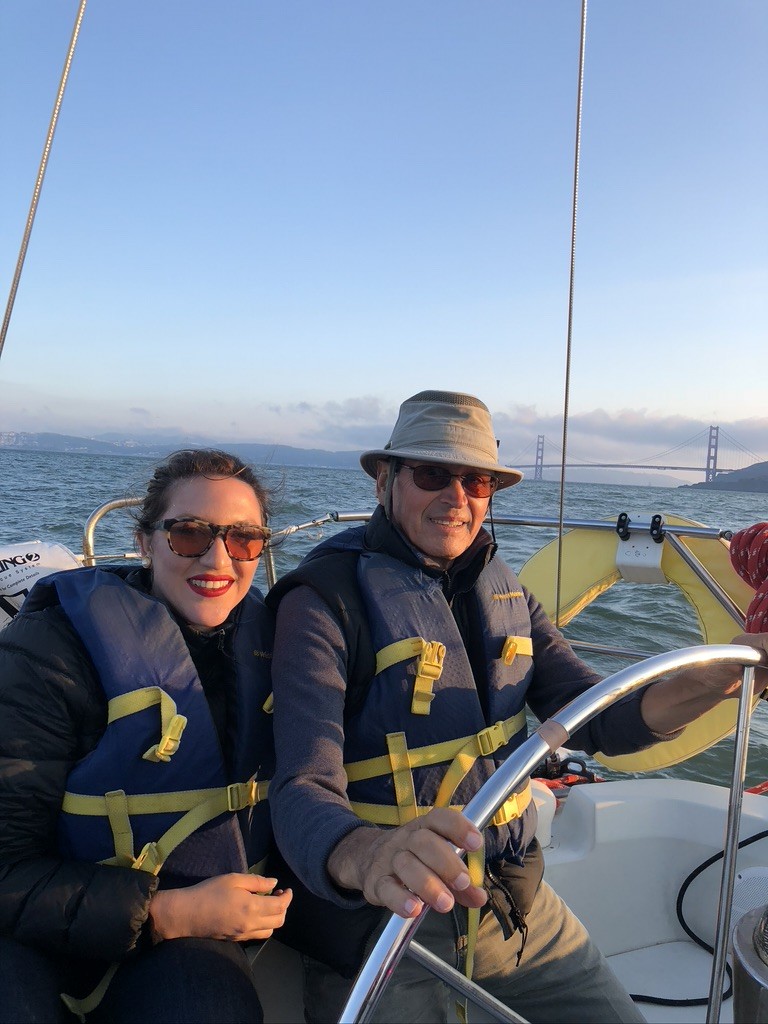
I open the FaceTime app, make sure my house and my kid are presentable (if you are Latino, you know), and press call. My father lives in Colombia, in a small town near Medellín, about 4,000 miles away. He has been fighting a chronic illness for over five years, layered on top of other health challenges, layered on top of losing my mother. He has buried two of his sons, his parents, his siblings, and his wife. He has already lost more than any one person should have to carry. On this call, he tells me he is struggling. Depressed. Anxious. Tired of trying a thousand medications, doctors, supplements, everything. He is at his wits’ end.
I hang up and look around at my life on a different continent. A new mom. A business. A family. And I feel so hopeless. There is so much technology available to us, and yet I can’t teletransport myself to hold my dad. Nothing replaces a real bear hug that says, “I don’t have all the solutions, but I am here to do this with you.”
That is the ache of loving someone from far away. Money doesn’t fix it. Video calls don’t fix it. And I go to bed wondering what he still has to fight for.
The grief you’re not supposed to feel yet
I speak a lot about anticipatory grief, the grief you feel when you know someone is going to die, but they are still with you. It is a deep, lonely grief, because you are not supposed to feel sad when your loved one is still alive. That is exactly what I felt when I hung up with my dad that day.
As immigrants, we carry extra layers of grief that often go unrecognized. There is a name for it: disenfranchised grief. The grief others don’t fully validate. We feel it in the big moments — missing a funeral because we cannot afford the flight, grieving alone in a country where no one else knew the person we lost. We feel it in the small moments, too. When we can’t speak our mother tongue. When our parents miss watching our children grow up. When we grieve a holiday from across an ocean. These are not dramatic losses. They are quiet and daily. And they accumulate.
This grief also makes the hard conversations harder. When you are already carrying so much, it feels easier to avoid adding more weight. But here is what I have learned: the conversations are not the weight. The silence is.
Why we have to start talking now
My family has always been open. My parents involved my sister, my brother, and me in decisions from the time we were young. Even when our voices didn’t change the outcome, they made sure we understood the “why.” My mom and my brother both died after fighting cancer.
There were big and small decisions to make, and being part of those conversations made it a little easier. It didn’t change the outcome. But it made us feel like we were doing it together.
I think about that a lot now with my dad.
He is stubborn in the best way. A man who was still doing 70km bike rides and triathlons in his 60s. He does not see himself as someone who needs to plan for the end. But I see a human doing human things. I fear for him when I am this far away. So I use our conversations to build a plan, not because I want control, but because knowledge is power. For him and for me.
When we know what he wants, my sister and I can honor it. And when he knows we are ready to support him the way he wants to be supported, I think it takes something off of him. We finally get to give back what he spent his whole life giving us.
I will never forget a conversation my mom had with her mother in her last days, because I repeated it back to my mom when it was her own last days. My grandmother was a very respected, elegant woman. At one point she could no longer take care of herself, and my mom had to help her with very personal things, like taking her to the bathroom or helping her with a shower. My grandmother told my mom she was very ashamed. That was a big word in our family, in Colombia. My mom replied: “You took care of me as an infant; now it is my turn. It is my honor.”
Years later, when it was my mom’s final days, I took on those same tasks when I could. She said the same thing her mother had said to her: “I am so sorry you have to do this for me.”
And I told her exactly what she had told her mother: “It is my honor to take care of you like you took care of me.” Now, as a mother myself, I really hope my kid takes care of me in my last days in the same caring and loving way I am taking care of him now.
How to start the conversation, even from far away
We grow up knowing that caring for our elders is an honor. Not having the chance to do that in person is one of the hardest parts of living so far away. So I find other ways to show up.
Sometimes those ways start with a joke.
My family have been cattle ranchers for at least three generations. My dad has a terrible memory, and we joke that when he eventually gets amnesia, we’ll send him to the family farm. Let him spend his days with the ranch hand, talking about where to move the cattle. That is what makes him happy. What started as a joke became a real conversation: what would he need at the farm? What kind of care would that require? What matters to him day to day? Humor opened a door that a direct question might have closed.
Not everyone grew up talking about this stuff. Our cultures don’t always make room for it. Our parents don’t always welcome it. And when you are thousands of miles away, it can feel impossible to bring up something this heavy over a phone screen.
But you don’t have to open with the hard question. You just have to start somewhere. A few things that have worked for me and people I’ve walked alongside:
Use a story as an entry point. Something happened to a friend, and it got you thinking: “It made me wonder if we’ve ever talked about what you would want if something like that happened.” Low stakes. A way in.
Shift from problems to wishes. Instead of focusing on what’s going wrong, try asking: “What’s important to you right now? What do you wish you could do more of? How can I help you get there?” These questions open things up instead of putting someone on the defensive.
Use yourself as the bridge. With my husband, I’ll say: “I know what my dad wants when he dies. Do you know what your mom would want?” It takes the weight off the person you’re most worried about and makes it a conversation everyone is part of.
Follow up on what’s already happening. My sister has her own health concerns. After her doctor’s appointments, I call and ask what the doctor said and what she wants to do. I especially will ask about the next steps. Small follow-up questions naturally build toward bigger ones.
Name your own fear first. I’ve told my dad: “My mom’s diagnosis came so late, and it scared me. Can we talk about making sure that doesn’t happen to you?” When you go first with your own fear, it gives the other person permission to do the same.
Use the tools that exist. The Conversation Project has a free Conversation Starter Guide, available in Spanish and other languages, that you can go through together on a video call. You don’t have to know where to begin. That’s what it’s for.
Make it more than one conversation. This is not one phone call. It is a direction you start moving in together, a little at a time.
Build a circle around them. Who is near your loved one physically? A sibling, a neighbor, a friend? Part of loving from far away is knowing who can show up when you can’t, and keeping those people in the loop.
What changes when you do
After my dad told us he had hit rock bottom, my sister and I got to work: learning what health coverage he has, what support exists, and what he actually wants for his day-to-day life. All of it changed how we show up for him. We stopped waiting for a crisis.
Before this, I had always told my dad I didn’t want to take over the farm. After my brother died, I stayed away from it. I honestly hadn’t paid much attention to how it worked. But when my dad asked for help, I started showing up for those calls. I started learning. My dad actively manages one farm with about 300–500 animals. I have taken some things off his plate that I know weigh on him. It is not perfect. It is not easy. But it is how I get to love him from here.
And honestly, it has brought us closer. I can have real conversations with him now about the things he actually cares about. Those are the calls that feel like a hug even when I’m 4,000 miles away.
When we know what our loved ones want, it gives everyone more power. It gives them peace knowing their wishes will be honored. It gives us peace knowing we won’t be scrambling or grieving decisions we never got to make together.
Closing
Some nights I still open that FaceTime app and press call, not knowing what I’ll find on the other end. A hard day. A better day. My dad tired. My dad is proud of something he did at the farm. I can’t be there in person. I can’t give him that bear hug. But I can show up to the conversation. I can keep asking. I can keep listening.
It is not easy being 4,000 miles away. It is not easy watching someone carry so much through a screen. But these conversations have changed my relationship with my dad, my sister, and, honestly, with myself.
There is still so much to figure out. But we are starting. And that is what matters.
If you don’t know where to begin, start with one question on your next call. The Conversation Project has a free guide, available in English, Spanish, Portuguese, and Chinese, that can help you open the door.
It is not easy, but there are a million ways to start the conversation. It is necessary to start as soon as possible so we can all properly take care of those we love, even when we are a million miles apart.
Patty Montoya (she/her) is a Master of Social Work candidate in the Clinical Specialization track, a certified death doula, and a grief and trauma coach. She is the founder of Titipoza, a practice integrating energy work, somatic ritual, and ancestral healing modalities to support clients through loss and life transitions. Patty’s clinical training is grounded in a deeply personal relationship with grief, having navigated significant loss within her own family and across borders. She brings this lived experience into both her academic work and her practice, with particular focus on anticipatory grief, disenfranchised grief, and end-of-life care planning for immigrant and first/second-generation families.