

As someone who does research on health care through the end of life, I get into a lot of conversations with people who are looking for advice as they face difficult decisions. People reach out to me when they, or their parents, or their spouses, are seriously ill or dying. They ask me what to do, how to make sense of health care, and how to think about their next steps. For a long time I have suggested to people that they look at wonderful online resources that are designed to help, like The Conversation Project or 5 Wishes.
But a recent conversation made me realize that piece of advice might not be as helpful to people as I thought it was. People might need more guidance than just a website link.
One day a friend called and asked if we could talk about a family situation where they were experiencing a lot of frustration and pain. One family member was getting close to the end of life and did not want to have more treatment. Their spouse was extremely upset about this, and my friend was hoping to facilitate some conversation.
I shared the usual resources. But as I talked with my friend, I realized that it was hard for him to envision what these resources were and how he could use them. I ended up reading sections of a worksheet over the phone to paint a picture.
Here is a breakdown of some features of these two resources from my perspective, and thoughts about when each one might be most useful. If you are already familiar with one or both of these resources, I hope this can help you talk about them with people in your life.
The Conversation Project
As you may know, The Conversation Project (TCP), created in 2010, is an initiative of the Institute for Healthcare Improvement, a nonprofit organization.
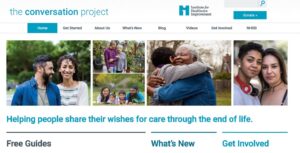
Some things I like about TCP include:
- It’s research-based (see resources for health care teams here)
- Their conversation starter guide is FREE. It’s available as a PDF here.
- I also like the content, especially if someone may need a conversation about various health care services for serious illness (like palliative care) or end of life (like hospice). TCP connected to those specific topics in ways that are completely aligned with everything I have learned in my research with palliative care providers.
TCP’s starter guide is organized around four steps: Think About What Matters to You, Plan Your Talk, Start Talking, and Keep Talking. I think it’s powerful to acknowledge that these conversations often do not happen in one fell swoop but take time. I also like how we are encouraged by TCP to gather our thoughts before the conversation.
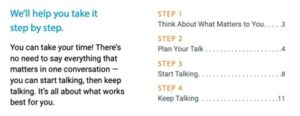
The Conversation Starter Guide is organized around 4 steps (from page 2)
Then, as you get further into the guide, the pages look like worksheets you can fill out. Here is the page for Step 1 (the other steps are different lengths but have a similar format).
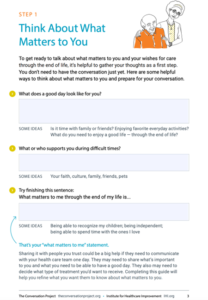
An excerpt from page 3 of TCP’s Conversation Starter Guide
Thinking about Right Now
The guide also encourages us to think about what a good day looks like right now. In my research, I find that people have trouble thinking about quality of life in terms something other than whether or not they would want to be on a ventilator. Often, the keys to thinking about these topics are things that you might be doing right now, while you read this. Drinking coffee? At home? With someone you care about? TCP gives you permission to see quality on those terms, and helps you share that perspective with people who might be caring for you.
5 Wishes
5 Wishes was established in 1998 and stems from the non-profit organization Aging with Dignity. The organization characterizes itself as the “first advance care plan (ACP) to address personal, emotional, and spiritual wishes, in addition to medical treatment.”

The 5 Wishes you discuss are:
- The person I want to make care decisions for me when I can’t
- The kind of medical treatment I want or don’t want
- How comfortable I want to be
- How I want people to treat me
- What I want my loved ones to know
5 Wishes also has a great overview video here with more details.
Some things I like about 5 Wishes include:
- 5 Wishes is designed to serve as an advance directive. They sought input from the American Bar Association for legal expertise and have information for each state in the US. The wishes have been translated into 30 languages.
- 5 Wishes can generate a legal document that you can upload and use in place of outdated documents you want to replace.
- The trade-off is that you can see a free sample PDF online for 5 Wishes but need to pay to have a digital ($7.50) or paper ($5) version (with discounts for volume).
Takeaways
When thinking about these two resources, I think 5 Wishes is great for families that want to talk about these topics generally and need an ice-breaker, but do not have an urgent need to make decisions, and also for those looking for support with legal documentation. The Conversation Project’s resources can be used at any stage, including if there are more immediate questions about what support to seek for care through the end of life.
I’ve described these resources from my own perspective here. For you, different examples might stand out to you to show what’s important about each resource. Or, you may know of other great resources.
If you hear from people in your own life who may be looking for support, remember to get specific. When you’re talking about these resources — or others — don’t just send a link. Give examples from YOUR perspective of what they are, what you like about them, and how they can help. Your descriptions will be unique to you. That gives you the best chance of being helpful to someone.
Dr. Karen Lutfey Spencer is a medical sociologist and professor at the University of Colorado Denver, where she researches medical gaslighting and end-of-life healthcare. Her new book, Your Good Death: Why End-of-Life Healthcare Is So Difficult and How to Make It Work for You, comes out September 1.