

It’s not unusual for health care team members, whether you’re a physician, nurse, or other valued member of the team, to have difficulty knowing where to start when approaching conversations about end of life.
Below are six resources that are filled with useful conversation starter tips and language that can be used or adapted to your situation. Each has a sample of what’s in the resource, so you can find what will work best for you.
1. How to Talk to Your Patients about End-of-Life Care: A Conversation Ready Toolkit for Clinicians
This toolkit is intended to help clinicians address some of the challenges of engaging with patients and families over time in conversations about care through the end of life.
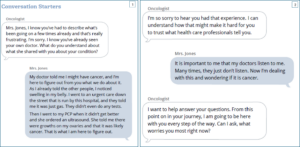
Examples of conversation starters in the toolkit
The kit contains four cases of patients at different points of illness, as well as diverse clinicians and care settings, and outlines key considerations for clinicians to engage the patient and family in discussions about what matters most to the patient at the end of life.
2. How to Have Conversations with Older Adults About “What Matters”: A Guide for Getting Started
A short guide for anyone who cares for older adults, in any setting, to help jumpstart conversations about What Matters most.
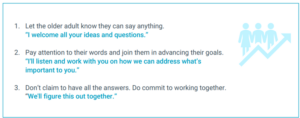
Sample tips from the guide for talking with older adults about what matters
The guide has steps for care team members to get started quickly, adapt as you go, and embed conversations about What Matters into your practice. It includes tips to open up any conversation about What Matters to the older adult, no matter what stage they are in their health care journey.
3. 5 Simple Phrases to Transform Conversations with Seriously Ill Patients
In this piece, Dr. Matthew Tyler shares, “Despite the frequency of these conversations, most medical professionals receive little formal training in facilitating bedside discussions where emotionally-charged, complex medical decisions must be made. Here are five simple but powerful phrases that can transform these difficult conversations such that both you and your patient will feel more prepared for the important decisions ahead.”
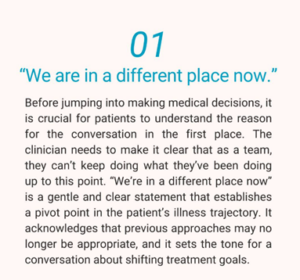
Example of a phrase to transform conversations
4. Serious Illness Conversation Guide
Created by Ariadne Labs, this guide can be used to talk with patients about their goals and values.
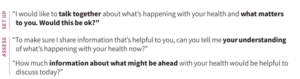
Example of language for setting up a conversation and assessing a patient’s understanding and preferences
Use the guide to set up a conversation, assess the patient’s understanding of their illness and preferences for receiving information, share a prognosis, and more.
5. What Matters to Me: A Workbook for People with Serious Illness
This workbook was jointly created by Ariadne Labs and The Conversation Project to help people with a serious illness think through and talk about what matters most to them — to help them get the care they want. This guide can help clinicians understand these conversations from the patient’s perspective.
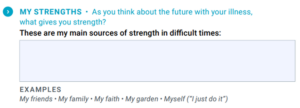
Example of a prompt to help individuals think about what’s important to them
The guide can be shared with patients ahead of or during an appointment; they can take it home to help them think further about what is important to them.
6. Your Guide for Talking with a Health Care Team
While this is a guide to help patients engage their health care team about care wishes now and through the end of life, it also offers insights into questions and prompts that could help you initiate these conversations as a health care professional. Many clinicians have shared they found this guide helpful to understand the patient’s perspective. This guide can be shared with individuals ahead of an appointment.
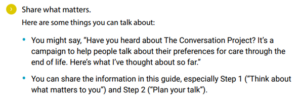
Example of questions from a patient’s perspective
Each of the resources above provides guidance that you can use to help start a conversation. Remember, putting the person at the center requires listening, empathy and understanding. You don’t have to have all the answers. If you haven’t yet thought about and talked to those important in your life about what matters when it comes to your own care and wishes, that is the first place to start. Start personally and use personal experience as a bridge toward understanding how these conversations matter.
You can also jump directly to the “Resources for Healthcare Professionals” page on The Conversation Project’s website to find these resources, and more, in one place. For example, the white paper “Conversation Ready”: A Framework for Improving End-of-Life Care” is a detailed framework to help health care organizations improve conversations and care through the end of life.
Are these resources helpful? What other resources do you know of that could also help? Please share in the comments section below.